Skip to content
Streambay
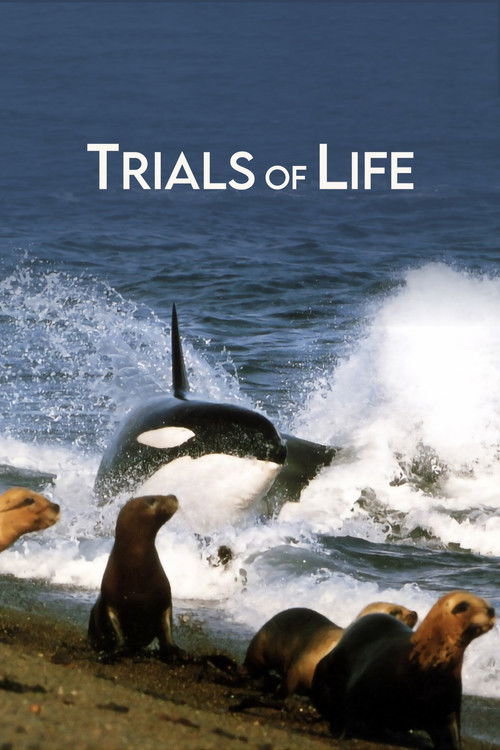
Trials of Life poster
TV series

Trials of Life

Latest episode

S1 E12 · Continuing the Line

About Trials of Life

Trials of Life is a family and documentary TV series that premiered on BBC One on October 4, 1990. It has 1 season and 12 episodes so far and has ended. The latest episode, Season 1 Episode 12 "Continuing the Line", aired on December 20, 1990.

Each of the twelve 50-minute episodes features a different aspect of the journey through life, from birth to adulthood and continuation of the species through reproduction.

  • Family
  • Documentary

Last updated

Episodes

12 episodes · 1 season

Season 1

1990 · 12 episodes · Last episode: 35 years ago

Trials of Life Season 1 release dates →
  1. Trials of Life S1 E12 still E12

    12. Continuing the Line

    Finale

    The final installment illustrates how species fulfill their ultimate raison d'être and ensure that their genes are passed on to the next generation. It is a universal problem, but one which has given rise to a variety of solutions. Barnacles cannot move, but each has both male and female sex cells, allowing each neighbour to be a potential mate. On the other end of the scale, a female elephant undergoes a long pregnancy - 22 months - and so wishes to ensure that her calf is fathered by a strong and proven male. She is therefore very choosy about her partner. A female chinchilla is even more so, and rejects an unwanted suitor by squirting urine in its face. Mating is a dangerous business when weapons are involved, and a male tarantula approaches his intended with trepidation. Only when he succeeds in holding off her poison fangs is he able to progress any further. For some, the right moments to get together are few and far between: a male crab, for example, must wait until a female moults her shell before he is able to fertilise her. Male sea lions are shown fighting over a harem, and some use the battle to their advantage by making off with reluctant females. Attenborough observes that the monogamous relationships enjoyed by humans are rare within the animal kingdom, but he highlights the Royal albatross as a "beautiful" exception. The pair of birds featured met as five-year-olds, and have been together for twenty years.
  2. Trials of Life S1 E11 still E11

    11. Courting

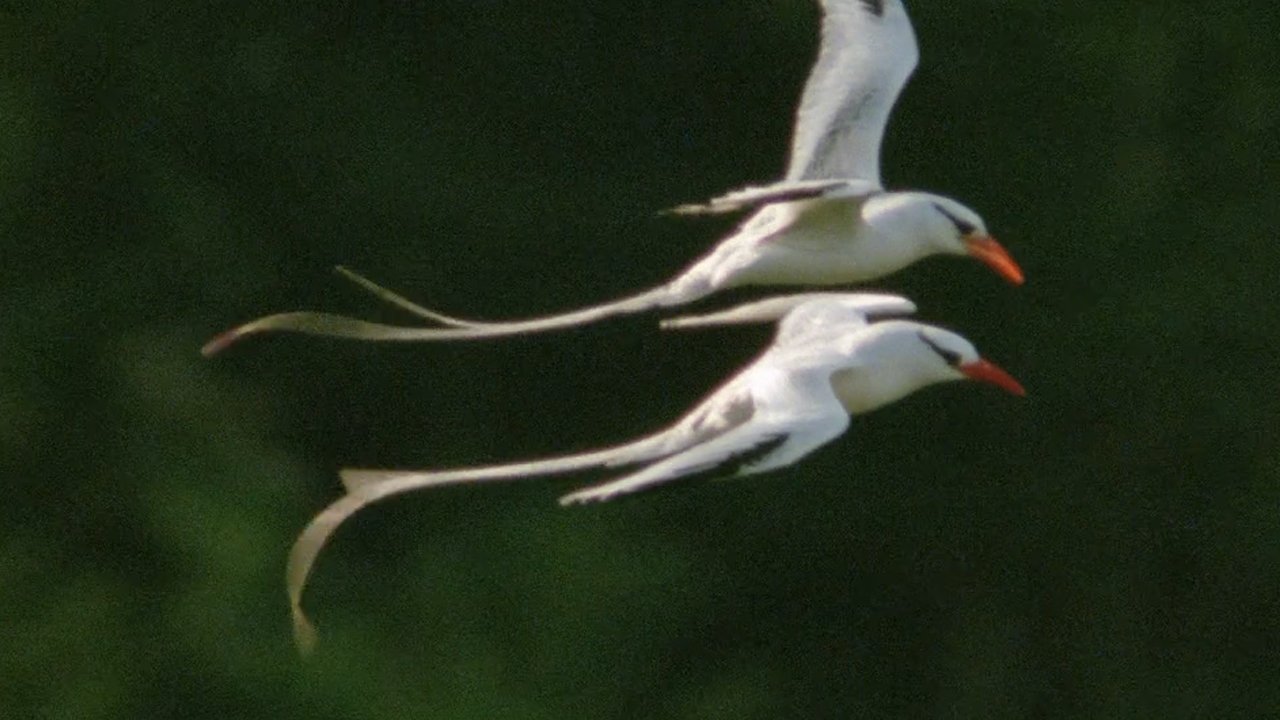
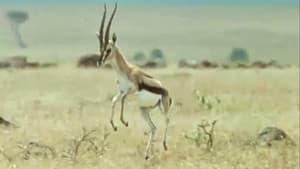
    This programme surveys the methods employed in attracting a mate, mainly those of birds. The Indian florican inhabits long grass, and so is difficult to see. In order to gain attention, it 'trampolines' in the same spot for up to 400 times a day. Whales sing to their prospective partners, and the female's calls can be heard by suitors for over eight kilometres. When animals send out signals of attraction, they must also ensure that they don't entice the wrong species, and so have markings that differ prominently. Attenborough highlights the booby as an example: there are around half a dozen species, all of which may occupy the same island. However, the blue-footed booby reassures its chosen mate by continually lifting its feet. Tropicbirds and marsh harriers are shown providing graceful aerobatic displays, while the sac-winged bat uses a strong perfume to lure a companion. Among those birds that produce the most spectacular visual displays are the lyrebird (which also has an elaborate song), the peacock, and the riflebird (and indeed most other birds of paradise). The bowerbird invites potential partners to inspect its bower: a specially prepared area that contains a hut or walkway augmented by strikingly coloured objects. The intricate dances performed by manakins in Trinidad are also examined. Finally, Attenborough observes the topi's display courts, whose sharply defined boundaries are jealously guarded by rival males.

  3. Trials of Life S1 E10 still E10

    10. Talking to Strangers

    This episode concentrates on communication. In Kenya, Attenborough accompanies a tribesman who calls to a honeyguide, which in turn answers him and leads the pair to a bees' nest. The tribesman extracts the honey, and some is left to reward the bird. African hunting dogs are shown hunting gazelles, of which the target is the individual that leaps lowest. Larks evade merlin by sending a similar message: by continuing to sing while being chased, it tells the pursuer that its prey is fit and therefore will be difficult to catch. (In 80% of cases this turns out to be true.) Vervet monkeys' cries are among the most complex. Their utterances are effectively words: a vocabulary that defines each of their predators, so an alarm call is specific to a particular threat. Some creatures transmit their presence by display, and Attenborough observes thousands of fireflies illuminating the darkness. Sounds travel further underwater, and over 200 species of fish use them to communicate. In turn, sea lions have become adept at sensing their proximity. However, the most visual aquatic animal is the squid, which uses colour change and posture to communicate. Finally, Attenborough swims with dolphins. They converse with a series of ultrasonic clicks, and each has a family call inherited from its mother: effectively a 'surname'. They also use normal sound, body posture and touch - in short, in terms of ability to communicate, they are man's closest rival.

  4. Trials of Life S1 E9 still E9

    9. Friends and Rivals

    This installment investigates the ways in which those animals that live in social groups interact with each other. The solitary eagle is contrasted with whooper swans landing in Scotland after a 1,600-kilometre journey from Iceland. Once arrived, they must battle for territory with those already there, and pairs or families are usually victorious. Attenborough uses a group of farmyard chickens to demonstrate a pecking order. A pride of lions is shown co-operating to subdue a buffalo. Afterwards, each animal peacefully awaits its turn at the carcass. Baboons live in troops of up to 150, and their complex dominance hierarchy is examined in detail. Vampire bats display mutual assistance by regurgitating blood for any neighbour that has missed out on a night's feeding. Dwarf mongooses live in family groups of around a dozen. While some look for food or sleep, others are always posted on the lookout for predators and quickly raise the alarm if necessary. Meanwhile, some of the most extreme co-operation is demonstrated by the underground naked mole rat, whose 80-strong clusters are divided into workers (who tunnel perpetually), soldiers (who only act when danger threatens), and a single queen for breeding. Leafcutter ants are shown transporting their food deep below ground: it has to be planted in a special fungus to remove its indigestible cellulose, and each stage of the operation is carried out by a different caste of individuals.

  5. Trials of Life S1 E8 still E8

    8. Fighting

    This programme details how fighting - both physical and psychological - is used for food, land or to gain a mate. Territorial conflict is demonstrated by the hummingbird, and Attenborough illustrates its aggressiveness by placing a stuffed specimen nearby, only to have it speared by its opponent's bill. The midas cichlid on the other hand, has no weapons to speak of, and so uses its mouth to hold on for trials of strength. By contrast, the forelegs of a mantis shrimp are powerful enough to crack the shell of another crustacean: therefore disputes or courtship are fraught with danger. Animals that possess lethal food-gathering weapons usually don't use them against one another, as neither side wishes to risk death. For example, one venomous snake will aim to floor the other, rather than bite. Wolves and big cats largely use snarls and body posture to convey their threat. There are no holds barred between rival zebras: kicking and biting is employed until a victor emerges, whereas giraffes slam their necks against each other. Normally peacable mountain gorillas are shown squabbling when play gets out of hand, and one of them communicates real fright by urinating uncontrollably. Large herbivores that have horns or antlers are naturally inclined to use them to assert their dominance over the females in a herd. Duelling male ibex and Alaskan bull moose undergo some of the most ferocious engagements - sometimes to the death.

  6. Trials of Life S1 E7 still E7

    7. Living Together

    This episode focuses on those species that co-operate and depend on (or exploit) others. Spotted deer follow langur monkeys as they travel from tree to tree, eating any leaves that get dropped from above. In return, the deer serve as a lookout when the primates are feeding on the ground. Underwater, a hermit crab is shown adding sea anemones to its shell in order to protect itself from attack by an octopus, and a goby assists a virtually blind shrimp. Fleas, lice and mites are parasites: they share no mutual partnership and instead take advantage of creatures for food or shelter. However, parasites have their predators, and an example are the finches of the Galápagos Islands that clear the resident giant tortoises of their ticks, and oxpeckers, which do the same for giraffes in Africa (and even use its fur to line their nests). Some fish regularly clean others, and wrasse and shrimp appear to specialise in this regard, as do remora, which permanently hang on to their hosts. One parasite that grows inside its host is the fluke, and one is shown gestating inside a snail, having previously been unknowingly eaten. Because it needs to transfer to a bird's gut to develop further, it causes the snail to advertise its presence to allow itself to be consumed - thus completing the circle. However, some microscopic creatures inhabit the stomachs of large herbivores in order to break down the cellulose of their diet, thereby aiding their digestion.

  7. Trials of Life S1 E6 still E6

    6. Home Making

    This installment deals with how animals construct their shelters from the elements and predators. Burrows and holes can provide considerable refuge, and Attenborough inspects the home of the American prairie dog, an elaborate construction that has its own air conditioning system. Silk is such a valuable commodity that those that can't make it steal it instead. The hermit hummingbird uses it to attach its nest to the underside of a leaf, while the Indian tailorbird stitches two leaves together. However, the expert in complex nest-building is the weaverbird which makes its abode from over 1,000 strips of grass that are perfectly interwoven - and dismantling it if it fails to attract a mate. The beaver is responsible for one of the biggest animal dwellings: its wooden lodge that rises from the river bed stays in place from one generation to the next, and so requires constant maintenance. Some stingless bees use their wax and the resin of tree bark to create labyrinthine structures containing various compartments. Mud is also used by several creatures, such as the potter wasp and the cliff swallow. The termites' intricate creations allow for security, heating, air conditioning, self-contained nurseries and gardens, and sanitation systems. Attenborough hails the species as the consummate home maker, and explores a 15-foot colony in West Africa that contains 1.5 million insects: he crawls right inside to examine its method of ventilation.

  8. Trials of Life S1 E5 still E5

    5. Finding the Way

    This programme explores forms of navigation. Attenborough starts in Africa at dusk, by describing some of the species that don't rely on sight. The spotted hyena uses its acute sense of smell to guide it while it hunts nocturnally, while galagos urinate on their hands so they can completely mark their movements. Some animals use echolocation and these include swiftlets, bats and river dolphins. By contrast, electric eels use fields of electricity to sense their environment. During the hours of daylight, other methods are employed: the rufous elephant shrew, with its carefully cleared network of pathways, has a sharp mental picture of its habitat - even knowing the various shortcuts with which to evade capture. Attenborough visits the Sahara to illustrate a species that makes the longest overland journey of any insect: cataglyphis, an ant that uses the sun's position to enable it to return to its nest in a straight line. Lobsters in the Bahamas are shown marching in columns to escape stormy waters. In its search for perpetual daylight in which to fish, the Arctic tern makes a 19,000-kilometre journey from one end of the Earth to the other. The albatross is highlighted as one of the most skilled navigators: it can travel up to 1300 kilometres over sea in search of food for its chicks, and still find its way back to the nest. Finally, Attenborough stands on a waterfall in Ireland to tell of the three-year, 10,000-kilometre journey made by elvers.

  9. Trials of Life S1 E4 still E4

    4. Hunting and Escaping

    This episode looks at those that hunt other creatures and ways of avoiding capture. Attenborough is attacked by a pair of skuas as he approaches their nest, which demonstrates this particular bird's aggressive behaviour, both when taking food and defending its young. Off the shores of Patagonia, the same group of killer whales returns each year to ambush sea lion pups, which stray out of the safer shallow waters. Having grabbed their prey, they take it back out to sea and 'play' with it for some time before killing it. Poison can be used both as a weapon and a deterrent, such as by the viper and tomato frog respectively. Some animals advertise their defensive measures in advance, in case deployment occurs too late. Among them are the skunk, which discharges an appalling smell, and some salamanders that display their toxicity by remaining stationary, with their warning markings visible. Several species of stick insect and their elaborate camouflage are shown. However, none of these methods of protection pose problems to army ants, which can subdue any of their prey, simply by virtue of their size and vast numbers. The Harris hawk is unusual, since it hunts in teams, and a group of six are shown practising their skill in the desert of New Mexico. The final sequence depicts a troop of chimpanzees displaying strategy and co-ordination as it successfully pursues colobus monkeys through a forest in the Ivory Coast.

  10. Trials of Life S1 E3 still E3

    3. Finding Food

    The next installment is devoted to the ways in which animals gather their sustenance. Attenborough begins in the South American rainforest, where the proliferation of animal and plant life does not necessarily make it easy to find food. Some leaves are poisonous, and so those that eat them have to be careful. Other plants use food (or nectar) as a bribe to get their pollen transported, and several species of hummingbird have developed exclusive relationships with certain of them. Fruit is also on offer, again as a means of reproduction, and creatures such as squirrel monkeys eat little else. Meanwhile, parrots and macaws take kaolin as an antidote to their diet of toxic seeds. Attenborough witnesses a 60,000 strong flock of knot and dunlin suddenly take advantage of a low tide to feed on tiny mud-dwelling molluscs. Barracuda hunt small fish, and drive shoals of them into bays to be eaten by pelicans, which are besieged by gulls that attempt to steal their catches. One species of gecko is able to differentiate between worker termites and the more dangerous soldiers. The web of the orb spider is hailed as one of the most elegant food catching devices, and the methods of two others, nephila and its kleptoparasite visitor, argyrodes, are explored in detail. Finally, tropicbirds, their crops full with food en route back to their nests, are ambushed in mid-air by a group of frigatebirds, whose aim is to make them surrender their cargo.

  11. Trials of Life S1 E2 still E2

    2. Growing Up

    This programme describes the ways that various species care for their young. Attenborough defines childhood as achieving two tasks: growing and surviving. He highlights the elephant seal as an animal that experiences a compressed childhood, being abandoned after three weeks and left for up to another eight alone, while it becomes large enough to be able to swim. For terns, there is safety in numbers as the dense population works together to drive out marauding gulls. The snow geese in the Russian arctic show intense devotion as they escort their goslings by foot to the coast some 50 kilometres away. Scorpions carry their young on their backs, while a shrew will leave hers under a stone while she goes to feed. The eider duck is one creature that shares responsibility for its offspring: females regularly supervise the ducklings of others in a group. The mara is another that uses a crèche system, as does the bat, whose nurseries can be up to a million strong. The Florida scrub jay has developed complex parental relationships, using teams rather than pairs. Such behaviour is exhibited on a larger scale by elephants, where all females take an interest in raising a single calf. A chimpanzee’s childhood is socially complicated, as an individual must learn how to behave towards others, as well as master the use of tools. Albatrosses must be accomplished fliers as soon as possible - chicks are shown being hunted by tiger sharks.

  12. Trials of Life S1 E1 still E1

    1. Arriving

    The first episode examines the various methods by which creatures come into the world. Attenborough’s opening statement alludes to the annual spawning of the Christmas Island red crab, of which there are estimated to be some 120 million. The exercise is all the more hazardous since the species is a land crab, and the eggs have to be deposited in the sea - where the most ancient animals on the planet still live and breed. One of the most prolific aquatic egg producers is the giant clam, but some land animals also lay vast quantities, and the mantis is one example. In the Western United States, Attenborough observes a wasp that digs a burrow, conceals it, and stocks it with fresh caterpillars for her emerging young. The grubs of another start life inside caterpillars, and eat the unsuspecting hosts. The problems of larger animals are illustrated by snow geese in the Arctic, which have to defend their eggs from arctic foxes. The process of embryonic growth inside the egg, from laying to hatching, is shown in detail. The malleefowl warms its eggs with rotting leaves, and Attenborough demonstrates the care with which it regulates them by adding sand to its mound - to have it kicked back in his face. The sea louse is a crustacean that commits suicide: its grubs consume so much of the mother’s energies that she dies after birth. Mammals shown giving birth to fully formed young include wildebeest, antelope, sea lions and chinchillas.

Trials of Life FAQ

Will there be new episodes of Trials of Life?

Trials of Life has ended, so no new episodes are scheduled. The final episode aired on December 20, 1990.

When did the latest episode of Trials of Life come out?

The most recent episode of Trials of Life, Season 1 Episode 12 "Continuing the Line", aired on December 20, 1990.

How many seasons of Trials of Life are there?

Trials of Life has 1 season with 12 episodes in total.

When did Trials of Life first air?

Trials of Life first aired on BBC One on October 4, 1990.

How do I get notified when new episodes of Trials of Life are released?

Download the Streambay app, follow Trials of Life, and you'll get a push notification the moment each new episode is released.

More like Trials of Life

  • Fuse poster

    7.6

    S47 · E136 18 years ago

    Fuse

    Synopsis: Fitil is a popular Soviet/Russian television satirical/comedy short film series which ran for about 500 episodes. Some of the episodes were aimed at children, and were called Фитилёк, Fitilyok, Little Fuse. Each issue contained from the few short segments: documentary, fictional and animated ones. Directed by various artists, including Leonid Gaidai who presented his famous trio of Nikulin, Vitsin and Morgunov into the cast. It was called in USSR as "the anecdotes from the Soviet government".

  • Nature poster

    7.9

    S45 · E3 1 week ago

    Nature

    Synopsis: Consistently stunning documentaries transport viewers to far-flung locations ranging from the torrid African plains to the chilly splendours of icy Antarctica. The show's primary focus is on animals and ecosystems around the world. A comic book based on the show, meant to be used an as educational tool for kids, was briefly distributed to museums and schools at no cost in the mid-2000s.

  • Mutual of Omaha's Wild Kingdom poster

    9.3

    S26 · E6 38 years ago

    Mutual of Omaha's Wild Kingdom

    Synopsis: Premiering in 1963 broadcast on prime-time from 1968-1971 and airing in syndication until 1988 the Emmy Award-winning Mutual of Omaha's Wild Kingdom was one of the longest-running and most beloved television series of all time. A pioneer of the narrative nature-documentary format the educational series followed venerable host and ecologist Marlin Perkins (later joined by Jim Fowler Peter Gros Stan Brock and Tom Allen) as he trekked to the farthest reaches of the globe to study wild animals in their natural habitats.

  • Mighty Machines poster

    6.0

    S3 · E1 17 years ago

    Mighty Machines

    Synopsis: Mighty Machines is a Canadian children's television show about machines and how they work. It airs on TVO, Treehouse TV and other channels in Canada, including Access in Alberta, the Saskatchewan Communications Network, and Knowledge in British Columbia. It also aired on Discovery Kids in 2005, on Qubo in the U.S., and a French-language version airs on TFO in Ontario and on channels in Quebec. It was nominated for a Gemini Award in 1996 in the category of Best Children's Program or Series. The full series is also available for instant viewing in the U.S. through Netflix and their streaming ser...

  • For Heaven's Sake poster

    7.7

    S20 · E13 5 years ago

    For Heaven's Sake

    Synopsis: Sister Hanna is a spirited, witty, resolute, warm-hearted, and - attractive nun. With her wit and street cred, she takes charge of Kaltenthal Cloister, transforming it into a popular refuge for all those seeking help of one kind or another. She also brings new life to the sleepy provincial community, proving herself quite a match for her great rival and opponent, the mayor Wolfgang Wöller.

  • Antiques Roadshow poster

    6.7

    S49 · E7 4 weeks ago

    Antiques Roadshow

    Synopsis: Antiques Roadshow is a British television show in which antiques appraisers travel to various regions of the United Kingdom to appraise antiques brought in by local people. It has been running since 1979. There are also international versions of the programme.

  • E=M6 poster

    6.5

    S36 · E8 2 weeks ago

    E=M6

  • Planet Earth III poster

    8.6

    S1 · E8 2 years ago

    Planet Earth III

    Synopsis: Journeying to the far reaches of our planet, this eight part series follows some of the world's most amazing species, telling extraordinary stories that are dramatic, thrilling, funny and sometimes heart-breaking, but always full of hope.

  • Who Do You Think You Are? poster

    7.0

    S23 · E8 3 months ago

    Who Do You Think You Are?

    Synopsis: A British genealogy documentary series in which celebrities trace their ancestry, discovering secrets and surprises from their past.

  • Circle of Life poster

    6.6

    S9 · E16 6 years ago

    Circle of Life

    Synopsis: Examining different species of animals as they grow to adulthood and learn life lessons that are sometimes difficult.

  • The Wonderful World of Disney poster

    7.9

    S34 · E26 36 years ago

    The Wonderful World of Disney

    Synopsis: Walt Disney Productions has produced an anthology television series under several different titles since 1954. The original version of the series premiered on ABC, Wednesday night, October 27, 1954. The show, which was hosted by Walt Disney until his death and then from 1996 to 2002 by then-CEO Michael Eisner (with one-off hosts or no hosts during other periods) has since aired continually as either a weekly program or an irregular series of specials on several networks and streaming services, most recently on ABC and Disney+. The show is the second longest showing prime-time program on Americ...

Never miss Trials of Life.

Download Streambay and follow Trials of Life. We’ll notify you the moment a new episode is released. It’s free, with no sign-up and no personal information required.

Coming soon to App Store Get it on Google Play
Trials of Life Get new episode alerts Get alerts