Skip to content
Streambay
Life in Cold Blood poster
TV series

Life in Cold Blood

Latest episode

S1 E5 · Armoured Giants

About Life in Cold Blood

Life in Cold Blood is a documentary TV series that premiered on BBC One on February 4, 2008. It has 1 season and 5 episodes so far and has ended. The latest episode, Season 1 Episode 5 "Armoured Giants", aired on March 3, 2008.

David Attenborough reveals the surprising truth about the cold-blooded lives of reptiles and amphibians. These animals are as dramatic, as colourful and as tender as any other animals.

  • Documentary

Last updated

Episodes

5 episodes · 1 season

Miniseries

2008 · 5 episodes · Last episode: 18 years ago

Life in Cold Blood Miniseries release dates →
  1. Life in Cold Blood S1 E5 still E5

    5. Armoured Giants

    Finale

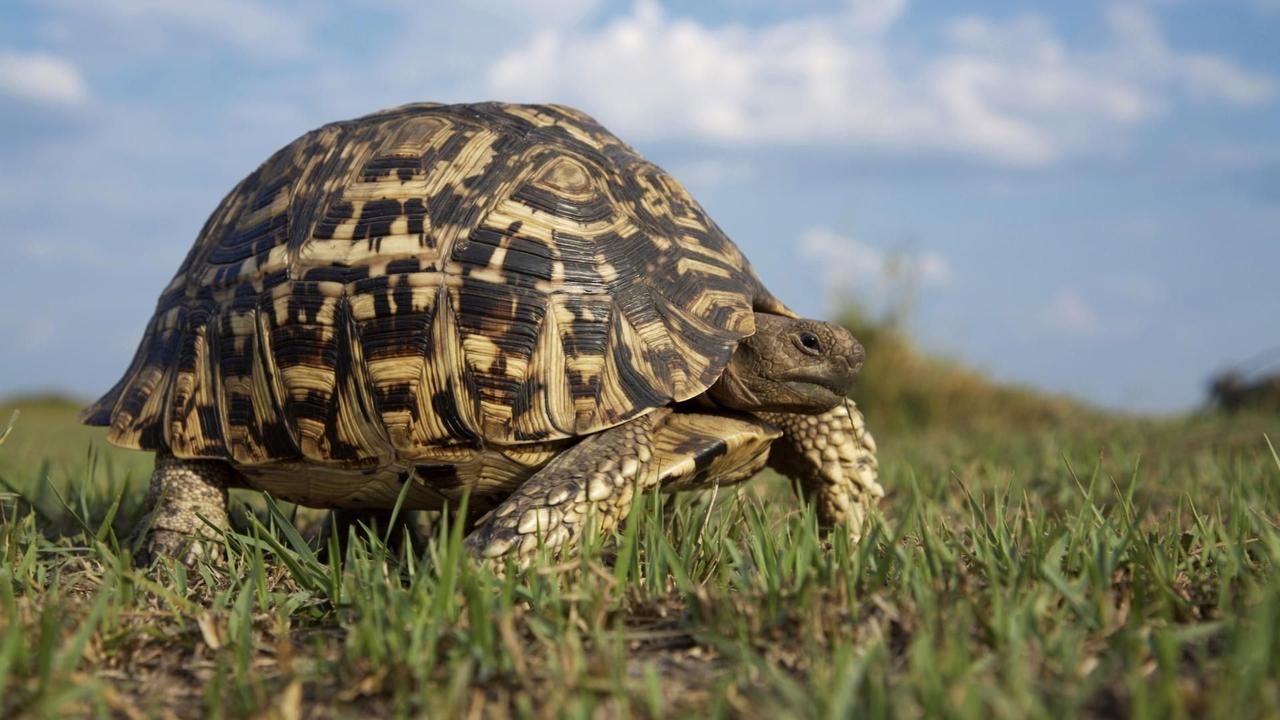
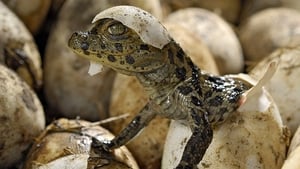
    The final programme covers the most ancient of the reptiles: the crocodiles and turtles. In the Galápagos Islands, among the giant tortoises, Attenborough explains how the creatures came to develop their shells as a defence against predators. This is demonstrated by the eastern box turtle, whose shell includes a hinged 'drawbridge'. The aquatic pig-nosed turtle is unusual in that its eggs need to be submerged before hatching, whereas those of other species would drown; Attenborough illustrates this by dropping an egg into a jar of water: it immediately hatches. In the open ocean, male sea turtles attempt to separate a rival from its mate by attacking and overwhelming the pair, stopping them from taking in air. In northern Australia, Attenborough observes a large gathering of crocodiles at a flooded coastal road: they time their arrival to ambush migrating mullet. The complex communication and body language of the American alligator is investigated and in Argentina, the calls of young caimans help their mother locate and lead them to a nursery pool. The mother's maternal instinct extends to releasing unhatched babies by gently crushing their eggs in its jaws. In Venezuela, a female spectacled caiman in charge of an entire crèche leads the infants from a drying river bed on a trek to permanent water
  2. Life in Cold Blood S1 E4 still E4

    4. Sophisticated Serpents

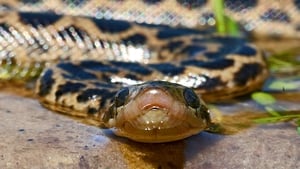
    The fourth episode focuses on the most modern reptiles, the snakes, exploring how they have managed to become successful despite their elongated body shape. Attenborough explains how they evolved from underground burrowers to surface hunters, losing their limbs in the process. With the aid of infrared cameras, a timber rattlesnake is shown lying in wait for a mouse and sensing its repeated path before despatching and eating it. A snake's constantly flickering tongue is used to gather and evaluate the molecules of its surroundings, and Attenborough visits Carnac Island to witness a population of blind tiger snakes, which feed on the chicks of nesting gulls. He also confronts a Mozambique spitting cobra, which quickly sprays venom over the presenter's protective face visor. The similarities in colouration between the harmless kingsnake and potentially lethal coral snake are highlighted. An example of a snake that can tackle unusual prey is the Queen snake, which almost exclusively hunts newly-moulted crayfish. A pair of rival male King cobras are seen battling and infant cobras are shown hatching: their venom is immediately as fatal as that of their parents. In Argentina, a yellow anaconda evades nearby caimans to give birth to live young. Finally a turtle-headed sea snake feeds not on fish, but on their eggs laid on a coral reef

  3. Life in Cold Blood S1 E3 still E3

    3. Dragons of the Dry

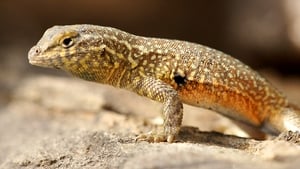
    The third instalment takes a look at the immense diversity, social skills and displays of the lizards. While they are highly adept at camouflage, occasionally there is a need to break cover in order to ward off rivals. Attenborough holds up a mirror to an anole and causes it to extend its colourful throat flap as a warning sign. Madagascar is host to over 60 species of chameleon but one of the largest, Meller's chameleon, is native to Malawi and two rival males are shown jousting. A female South African dwarf chameleon demonstrates its ability to change colour when communicating to a potential mate, and the chameleon's muscular tongue is depicted lassoing its prey. In southern Australia, Attenborough uses a baited fishing rod to attract the attention of a rare pygmy bluetongue skink, thought to have been extinct for over thirty years until it was rediscovered in 1992. Shinglebacks are among the most devoted lizards and breeding pairs can reunite each year for up to two decades. Alongside South Africa's Orange River, large groups of flat lizards feed on the swarms of black flies, but the males also use the occasion to indulge in social squabbling. The Mexican beaded lizard is one of the few with a poisonous bite, but males do not employ it when wrestling each other. Finally, Attenborough comes face to face with a perentie, Australia's largest monitor lizard. Under the Skin focuses on filming in Australia.

  4. Life in Cold Blood S1 E2 still E2

    2. Land Invaders

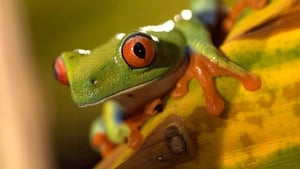
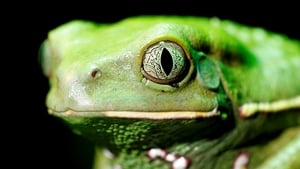
    The second programme explores the world of amphibians, of which there are some 6,000 known species. Attenborough visits Australia to illustrate how they became the first back-boned creatures to colonise land: the lungfish, which is capable of breathing air, and whose ancestors became the first amphibians. The largest of them is the Japanese giant salamander and two are shown wrestling for territory. In North America, the marbled salamander spends most of its life on land, yet is still able to retain the necessary moisture in its skin through the damp leaf litter. A female caecilian is filmed with her young, whose rapid growth is discovered to be the result of eating their mother's skin — re-grown for them every three days. The most successful amphibians are frogs and toads. Their calls are most active during the breeding season: females are impressed by both volume and frequency. However, gestures are sometimes needed and the poisonous Panamanian golden frog uses a conspicuous form of 'semaphore'. Most other frogs rely on camouflage and the South American red-eyed tree frog is an example. An African bullfrog is shown defending its exposed tadpoles by digging a canal for them. Meanwhile, the male marsupial frog keeps its young moist by carrying them in its skin pouches. Under the Skin examines the filming of the last population of Panamanian golden frogs, which is threatened by a fungal disease.

  5. Life in Cold Blood S1 E1 still E1

    1. The Cold Blooded Truth

    The first episode discusses the keys to success of reptiles and amphibians, looking at thermoregulation, parental care and the time-scales on which reptiles operate.

Life in Cold Blood FAQ

Will there be new episodes of Life in Cold Blood?

Life in Cold Blood has ended, so no new episodes are scheduled. The final episode aired on March 3, 2008.

When did the latest episode of Life in Cold Blood come out?

The most recent episode of Life in Cold Blood, Season 1 Episode 5 "Armoured Giants", aired on March 3, 2008.

How many seasons of Life in Cold Blood are there?

Life in Cold Blood has 1 season with 5 episodes in total.

When did Life in Cold Blood first air?

Life in Cold Blood first aired on BBC One on February 4, 2008.

How do I get notified when new episodes of Life in Cold Blood are released?

Download the Streambay app, follow Life in Cold Blood, and you'll get a push notification the moment each new episode is released.

More like Life in Cold Blood

  • Arena poster

    7.2

    S1 · E686 1 year ago

    Arena

    Synopsis: Arena is a British television documentary series, made and broadcast by the BBC. Voted by leading TV executives in Broadcast as one of the top 50 most influential programmes of all time, it has run since 1 October 1975 with over five hundred episodes made, directed by the likes of Martin Scorsese, Alan Yentob, Roly Keating, Frederick Baker, Volker Schlondorff and Vikram Jayanti. Arena's subjects are a roll-call of the world's best known cultural figures from the 20th and 21st centuries, from singers Bob Dylan and Amy Winehouse to academics Edward Said and Eric Hobsbawm, from writers Jean Genet...

  • The South Bank Show poster

    5.6

    S45 · E4 3 years ago

    The South Bank Show

    Synopsis: The South Bank Show is a television arts magazine show produced by ITV between 1978 and 2010. A new series began on Sky Arts from 27 May 2012. Presented by Melvyn Bragg, the show aims to bring both high art and popular culture to a mass audience.

  • Galileo poster

    4.8

    S14 · E235 4 years ago

    Galileo

    Synopsis: This daily German magazine show delivers interesting facts on numerous topics centering around technology, life, and bizarre knowledge.

  • Cosmic Disclosure poster

    10.0

    S30 · E11 6 months ago

    Cosmic Disclosure

    Synopsis: For the first time ever, a 30-year insider has come forward to reveal over 70 years of humanity's hidden history in space. Corey Goode joins David Wilcock in this inaugural presentation of Cosmic Disclosure to offer an overview of the history and extent of humanity's celestial presence.

  • Mayday poster

    8.2

    S26 · E10 7 months ago

    Mayday

    Synopsis: Major real-life air disasters are depicted in this series. Each episode features a detailed dramatized reconstruction of the incident based on cockpit voice recorders and air traffic control transcripts, as well as eyewitnesses recounts and interviews with aviation experts.

  • Fuse poster

    7.6

    S47 · E136 18 years ago

    Fuse

    Synopsis: Fitil is a popular Soviet/Russian television satirical/comedy short film series which ran for about 500 episodes. Some of the episodes were aimed at children, and were called Фитилёк, Fitilyok, Little Fuse. Each issue contained from the few short segments: documentary, fictional and animated ones. Directed by various artists, including Leonid Gaidai who presented his famous trio of Nikulin, Vitsin and Morgunov into the cast. It was called in USSR as "the anecdotes from the Soviet government".

  • Great Performances poster

    6.1

    S55 · E4 1 week ago

    Great Performances

    Synopsis: The best in the performing arts from across America and around the world including a diverse programming portfolio of classical music, opera, popular song, musical theater, dance, drama, and performance documentaries.

  • NOVA poster

    7.1

    S53 · E16 5 days ago

    NOVA

    Synopsis: PBS' premier science series helps viewers of all ages explore the science behind the headlines. Along the way, NOVA demystifies science and technology, and highlights the people involved in scientific pursuits.

  • Fantástico poster

    8.4

    S54 · E45 Yesterday

    Fantástico

    Synopsis: 'Fantástico' is a journalistic program shown on Sundays, presented by Poliana Abritta and Maju Coutinho. Every week, he presents special reports, shows and various paintings.

  • 20/20 poster

    6.3

    S50 · E3 1 month ago

    20/20

    Synopsis: 20/20 is an American television newsmagazine that has been broadcast on ABC since June 6, 1978. Created by ABC News executive Roone Arledge, the show was designed similarly to CBS's 60 Minutes but focuses more on human interest stories than international and political subjects. The program's name derives from the "20/20" measurement of visual acuity. The hour-long program has been a staple on Friday evenings for much of the time since it moved to that timeslot from Thursdays in September 1987, though special editions of the program occasionally air on other nights.

Never miss Life in Cold Blood.

Download Streambay and follow Life in Cold Blood. We’ll notify you the moment a new episode is released. It’s free, with no sign-up and no personal information required.

Coming soon to App Store Get it on Google Play
Life in Cold Blood Get new episode alerts Get alerts