
Skip to content
Streambay
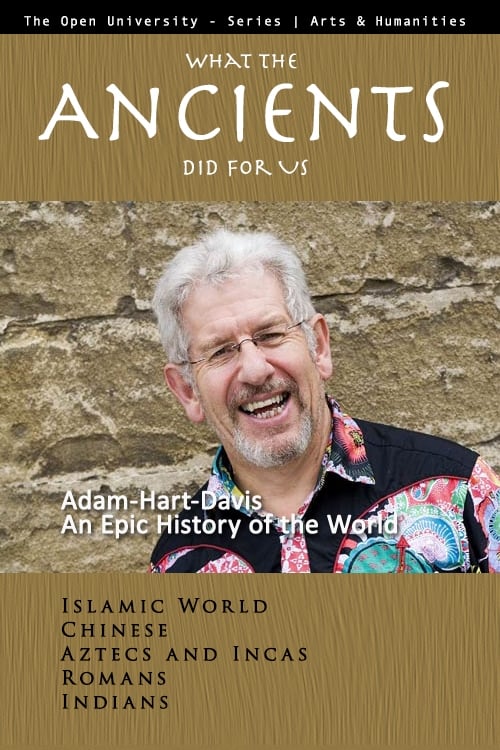
What the Ancients Did for Us poster
TV series

What the Ancients Did for Us

Latest episode

S1 E9 · The Britons

About What the Ancients Did for Us

What the Ancients Did for Us is a documentary TV series that premiered on BBC Two on February 16, 2005. It has 1 season and 9 episodes so far and has ended. The latest episode, Season 1 Episode 9 "The Britons", aired on April 13, 2005.

What the Ancients Did for Us is a 2005 BBC documentary series presented by Adam Hart-Davis that examines the impact of ancient civilizations on modern society.

  • Documentary

Last updated

Episodes

9 episodes · 1 season

Season 1

2005 · 9 episodes · Last episode: 21 years ago

What the Ancients Did for Us Season 1 release dates →
  1. E9

    9. The Britons

    Finale

    A lot of people still think that we were just woad-covered savages before the Romans came along. Well, we weren't - firstly we weren't covered in woad but dressed in a rather elegant new-fangled invention - trousers; more importantly we were organised, spiritual, technologically advanced Brits with European business connections – all without towns and cities or being able to read and write! This programme shows the evolution of the people of Britain from Stone Age hunters to Iron Age warriors. From early people who used animal bone picks to dig mines to a society skilled in the use of metallurgy, bronze, iron and gold. From a nomadic existence to a society organised into tribes with their own coinage and identities. From farmers using simple wooden ploughs to ferocious warriors driving thousands of chariots and repulsing the invading Roman army of Julius Caesar.

  2. E8

    8. The Greeks

    The ancient Greek civilisation flourished for about a thousand years, not as a unified country but rather as a loose association of city states, both on the mainland of Greece and elsewhere around the Mediterranean. The philosopher Plato described the states as being like a series of frogs sitting around a pond. Although the Greeks drew on the ideas of various earlier civilisations, they were the people who, more than any other, handed down to us the foundations of our democracy, our notions of ethics and justice, our science, our mathematics and our music. But it mustn't be forgotten that the Greeks were a warlike lot and in order to pursue their territorial ambitions they invented some deadly weapons – for instant take the bow and arrow. Aware of its limitations and short range they mechanised it like a giant cross bow. It was loaded by bearing down on it with your whole body weight and it became known as the Belly Bow. The Greeks also invented the catapult and designed monster machi

  3. E7

    7. The Egyptians

    Egypt became a unified country five thousand years ago and - until the arrival of Alexander the Great in 332 BC - remained a fiercely independent land with its own very distinctive art, religion and culture. Egypt was the superpower of its day and her kings were treated as demigods throughout the Mediterranean world – but what did they do for us? It goes without saying they gave us mummies and mummification, and one of the great wonders of the ancient world – the pyramids. On a more practical level they invented the sewn plank boat, a method of boat construction using wooden pegs and fibre rope - no nails. Huge boats were built using this technique, the most famous one belonging to King Khufu, the builder of the great pyramid in 2500 BC. The recent discovery of a Bronze Age boat in Britain reveals that this method of construction had found its way here and could have influenced our own boat builders. Trying to control the flood water of the Nile, the Egyptians built the first dam, a hu

  4. E6

    6. The Mesopotamians

    There has always been a great debate as to who kicked off civilisation: was it the Egyptians, the Greeks or the Romans? Well, actually, none of them did. Human history began in the great alluvial plain between the Tigris and Euphrates rivers, with its rich and immensely fertile soil: a land known as Mesopotamia. The people that dwelled here eight thousand years ago had learned to irrigate the land with canals and ditches, and were keen farmers. From this came plenty, which relieved man of the need to fight for survival. The Assyrian, Babylonian and Sumerian civilisations flourished here in an area stretching from modern Turkey, to western Syria, and Iraq. But what did they do for us? For a start, they invented writing, with the oldest book, the epic of 'Gilgamesh', written around 4,500 years ago. They also gave us the first written laws - apparently to restrain 'drunkenness' in the population; a side effect of another of their innovations, beer. They invented brick, which they produced

  5. E5

    5. The Indians

    India is one of the oldest and richest civilizations in the world. It is home to the world's first planned cities, where every house had its own bathroom and toilet five thousand years ago. The Ancient Indians have not only given us yoga, meditation and complementary medicines, but they have furthered our knowledge of science, maths - and invented Chaturanga, which became the game of chess. According to Albert Einstein, they ""taught us how to count"", as they invented the numbers 1-9 and 'zero', without which there would be no computers or digital age. Unfairly we call this system of counting Arabic numbers - a misplaced credit. Two thousand years ago the Indians pioneered plastic surgery, reconstructing the noses and ears on the faces of people who had been disfigured through punishment or warfare. They performed eye operations such as cataract removal and invented inoculation to protect their population from Smallpox, saving thousands of lives. To create images of their gods they inve

  6. E4

    4. The Romans

    The city of Rome was founded on the banks of the Tiber in 753 BC and for a thousand years the western world was ruled from within its walls. To support this vast Empire the Romans created complex infrastructure and used the techniques of mass production, centuries before the industrial revolution. In this programme Adam Hart-Davis will find out how the Romans managed to do so much, so long ago and discover just what the Romans did for us. For a start they created the first professional, salaried army and invented fearsome war machines. To move around the Empire they constructed thousands of miles of roads – and we find out what it actually takes to build one of these. They built amphitheatres and race tracks and in the process brought gladiatorial games and equine sport to every corner of their empire. They pioneered the mass production of glass and double glazing, and created enormous aqueducts that fed water from distant sources into the heart of their cities and bath houses, created

  7. E3

    3. The Aztecs, Maya and Incas

    These three peoples lived in a vast area of modern-day Central and South America which incorporates coastal strips, hot and steamy jungles, savannah grassland and cold windy highlands. Though they spoke different languages, they had broadly similar cultures and they worshipped many of the same gods (although they gave them different names). They all used digging sticks, ate maize and beans, respected the number 13 and practised human sacrifice. Interestingly, although they developed the wheel as a toy, for some reason they didn't adapt it for other purposes. The Aztecs built their settlement in a swamp in what is now Mexico City and when the Spanish arrived they thought it more spectacular than Venice. The Aztecs were fantastic warriors but they were also excellent farmers: because they had stumbled on hydroponics, their floating fields produced an abundance of nutrients in the food they were growing. The Mayas built some of the tallest buildings of the ancient world – without the use

  8. E2

    2. The Chinese

    China is the fastest growing economy on earth. One in four of every person on the planet is Chinese, and Shanghai is six times the size of London, offering a home to twenty million people. But while China is developing rapidly now, the Chinese civilisation is one of the oldest surviving in the world. The ancient Chinese thought they were at the centre of universe. Cut off from the rest of the world for centuries the Chinese developed a unique culture, and made many technological, scientific and artistic advances long before the West. Programme two of What The Ancients Did For Us explores this amazing country and the inventions of these ingenious people. The people who gave us the world's first fast food including what we call pasta - the noodle. To pay for this delicacy, they came up with paper money, printing with moveable type and a unified system of weights and measures. To move all their goods they invented canals, and the unique segmented arched bridge. To protect their new border

  9. E1

    1. The Islamic World

    The rise of Islam is one of the most important events in world history. In the 7th century, Mohammed's intention was to unite the divided Arabs through a new religion. A century after his death, he'd succeeded in producing a medieval superpower. The Arabs and Moors had spread through Spain towards the Pyrenees. Cordoba became renowned as one of the greatest and wealthiest cities in Europe. Moorish cities such as Toledo and Seville were famed for their new culture and universities. The first What The Ancients Did For Us programme explores the Muslim contribution to the western world - in art, architecture, astronomy, medicine, science, and learning. The early Muslims are credited with inventing distillation and could distil just about anything - from alcohol to perfume. Hygiene is very important in the Muslim world so they invented and manufactured soap - centuries before the West - and hundreds of bathhouses were built throughout Muslim cities. They understood the fundamentals of light

What the Ancients Did for Us FAQ

Will there be new episodes of What the Ancients Did for Us?

What the Ancients Did for Us has ended, so no new episodes are scheduled. The final episode aired on April 13, 2005.

When did the latest episode of What the Ancients Did for Us come out?

The most recent episode of What the Ancients Did for Us, Season 1 Episode 9 "The Britons", aired on April 13, 2005.

How many seasons of What the Ancients Did for Us are there?

What the Ancients Did for Us has 1 season with 9 episodes in total.

When did What the Ancients Did for Us first air?

What the Ancients Did for Us first aired on BBC Two on February 16, 2005.

How do I get notified when new episodes of What the Ancients Did for Us are released?

Download the Streambay app, follow What the Ancients Did for Us, and you'll get a push notification the moment each new episode is released.

More like What the Ancients Did for Us

  • Arena poster

    7.2

    S1 · E686 1 year ago

    Arena

    Synopsis: Arena is a British television documentary series, made and broadcast by the BBC. Voted by leading TV executives in Broadcast as one of the top 50 most influential programmes of all time, it has run since 1 October 1975 with over five hundred episodes made, directed by the likes of Martin Scorsese, Alan Yentob, Roly Keating, Frederick Baker, Volker Schlondorff and Vikram Jayanti. Arena's subjects are a roll-call of the world's best known cultural figures from the 20th and 21st centuries, from singers Bob Dylan and Amy Winehouse to academics Edward Said and Eric Hobsbawm, from writers Jean Genet...

  • The South Bank Show poster

    5.6

    S45 · E4 3 years ago

    The South Bank Show

    Synopsis: The South Bank Show is a television arts magazine show produced by ITV between 1978 and 2010. A new series began on Sky Arts from 27 May 2012. Presented by Melvyn Bragg, the show aims to bring both high art and popular culture to a mass audience.

  • Galileo poster

    4.8

    S14 · E235 4 years ago

    Galileo

    Synopsis: This daily German magazine show delivers interesting facts on numerous topics centering around technology, life, and bizarre knowledge.

  • Cosmic Disclosure poster

    10.0

    S30 · E11 6 months ago

    Cosmic Disclosure

    Synopsis: For the first time ever, a 30-year insider has come forward to reveal over 70 years of humanity's hidden history in space. Corey Goode joins David Wilcock in this inaugural presentation of Cosmic Disclosure to offer an overview of the history and extent of humanity's celestial presence.

  • Mayday poster

    8.2

    S26 · E10 7 months ago

    Mayday

    Synopsis: Major real-life air disasters are depicted in this series. Each episode features a detailed dramatized reconstruction of the incident based on cockpit voice recorders and air traffic control transcripts, as well as eyewitnesses recounts and interviews with aviation experts.

  • Fuse poster

    7.6

    S47 · E136 18 years ago

    Fuse

    Synopsis: Fitil is a popular Soviet/Russian television satirical/comedy short film series which ran for about 500 episodes. Some of the episodes were aimed at children, and were called Фитилёк, Fitilyok, Little Fuse. Each issue contained from the few short segments: documentary, fictional and animated ones. Directed by various artists, including Leonid Gaidai who presented his famous trio of Nikulin, Vitsin and Morgunov into the cast. It was called in USSR as "the anecdotes from the Soviet government".

  • Great Performances poster

    6.1

    S55 · E4 1 week ago

    Great Performances

    Synopsis: The best in the performing arts from across America and around the world including a diverse programming portfolio of classical music, opera, popular song, musical theater, dance, drama, and performance documentaries.

  • NOVA poster

    7.1

    S53 · E16 5 days ago

    NOVA

    Synopsis: PBS' premier science series helps viewers of all ages explore the science behind the headlines. Along the way, NOVA demystifies science and technology, and highlights the people involved in scientific pursuits.

  • Fantástico poster

    8.4

    S54 · E45 Yesterday

    Fantástico

    Synopsis: 'Fantástico' is a journalistic program shown on Sundays, presented by Poliana Abritta and Maju Coutinho. Every week, he presents special reports, shows and various paintings.

  • 20/20 poster

    6.3

    S50 · E3 1 month ago

    20/20

    Synopsis: 20/20 is an American television newsmagazine that has been broadcast on ABC since June 6, 1978. Created by ABC News executive Roone Arledge, the show was designed similarly to CBS's 60 Minutes but focuses more on human interest stories than international and political subjects. The program's name derives from the "20/20" measurement of visual acuity. The hour-long program has been a staple on Friday evenings for much of the time since it moved to that timeslot from Thursdays in September 1987, though special editions of the program occasionally air on other nights.

Never miss What the Ancients Did for Us.

Download Streambay and follow What the Ancients Did for Us. We’ll notify you the moment a new episode is released. It’s free, with no sign-up and no personal information required.

Coming soon to App Store Get it on Google Play
What the Ancients Did for Us Get new episode alerts Get alerts